
In today’s always-on world, boredom is often treated as something to eliminate as quickly as possible. Yet research increasingly suggests the opposite approach may be far more powerful. When paired with emotional intelligence, boredom creates the mental space necessary for creativity, innovation, self-regulation, and stronger problem-solving. Rather than being unproductive, moments of boredom allow the brain to pause, reflect, process emotions, and generate new ideas, supporting clearer thinking, deeper awareness, and more intentional action in both life and work.
The Power of Boredom: How Emotional Intelligence Turns Mental Space into Innovation
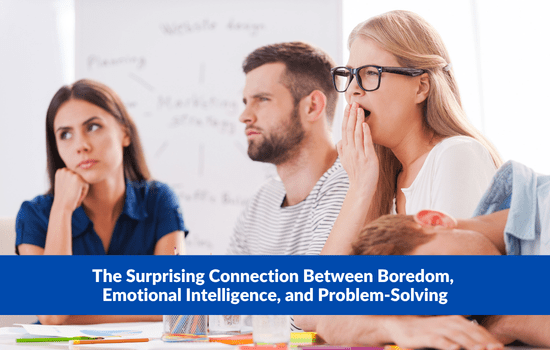
Innovation does not emerge from constant stimulation; it begins in moments of pause. When individuals have the emotional awareness to tolerate boredom rather than escape it, they create the mental and emotional space where original ideas take shape.
Boredom as an Emotional Intelligence Skill
From an emotional intelligence perspective, boredom is not a flaw; it is a signal. Psychologists define boredom as a state of low stimulation paired with a desire for engagement (Eastwood et al., 2012). Emotionally intelligent individuals recognize this signal rather than react impulsively.
This requires:
-
Self-awareness to notice discomfort
-
Self-regulation to resist immediate distraction
-
Motivation to remain open to reflection rather than avoidance
When boredom is met with emotional agility instead of reactivity, the brain shifts into the default mode network (DMN), a neural state associated with reflection, memory integration, and creative thinking (Raichle et al., 2001).
Why Innovation Begins with Boredom
Innovation is rarely born in moments of urgency; it develops in spaces where the mind can wander, connect, and imagine. Research shows that boredom enhances creative idea generation by encouraging daydreaming and abstract thinking (Mann & Cadman, 2014).
This is where boredom becomes an innovation accelerator. When stimulation decreases:
-
The brain makes unexpected connections
-
Old assumptions loosen
-
New perspectives emerge
Innovation requires uncertainty, and boredom creates the psychological conditions where uncertainty can be explored safely rather than avoided.
Emotional Regulation: Sitting with Discomfort Fuels Breakthroughs
Boredom often feels uncomfortable because it removes distraction. This discomfort is exactly where emotional regulation comes into play. Emotionally intelligent individuals are better equipped to tolerate this unease rather than suppress it.
Research shows that individuals who can manage boredom demonstrate greater emotional resilience and attentional control (Danckert & Merrifield, 2018). This ability is essential for innovation, which inherently involves ambiguity, delayed outcomes, and risk.
In other words: Innovation requires emotional stamina, and boredom helps build it.
Neuroplasticity, Reflection, and Innovative Thinking
Periods of mental rest support neuroplasticity, the brain’s ability to reorganize and adapt. When the brain is not locked into task-driven stimulation, it strengthens networks related to imagination, foresight, and ethical reasoning (Immordino-Yang et al., 2012).
From an emotional intelligence lens, this reflective space allows individuals to:
-
Align ideas with values
-
Consider long-term impact
-
Engage in deeper problem-solving
Innovation that lacks reflection may be fast, but innovation grounded in EI is sustainable and meaningful.
Problem-Solving Requires Mental Incubation
Some of the most effective solutions emerge when we stop actively forcing them. The incubation effect explains how stepping away from a problem allows unconscious processing to continue (Sio & Ormerod, 2009).
Boredom creates this incubation window. Emotionally intelligent leaders and professionals understand that not thinking harder, but thinking differently, often leads to better solutions.
Boredom is not a productivity killer; it is an innovation gateway. When paired with emotional intelligence, boredom strengthens creativity, fuels innovation, enhances self-regulation, and improves problem-solving.
In a workplace culture driven by constant stimulation, the ability to pause and reflect is a competitive advantage. Through emotional intelligence and self-regulation, individuals strengthen creativity, fuel innovation, and improve problem-solving by creating space for clearer thinking and intentional action. Organizations that prioritize emotional intelligence foster cultures where innovation is sustainable, not accidental. At Marshall Connects, Emotional Intelligence Assessments and Coaching help leaders strengthen self-awareness, resilience, performance, and long-term professional growth through the EQ-i 2.0 Assessment.
More Motivational Reads Here »
How Emotionally Intelligent Are You?
Sign up for Linda’s monthly tips to build your Emotional Intelligence and reduce Emotional Hijacking!
References
Danckert, J., & Merrifield, C. (2018). Boredom, sustained attention and the default mode network. Experimental Brain Research, 236(9), 2507–2518. https://doi.org/10.1007/ s00221-016-4617-5
Eastwood, J. D., Frischen, A., Fenske, M. J., & Smilek, D. (2012). The unengaged mind: Defining boredom in terms of attention. Perspectives on Psychological Science, 7(5), 482–495. https://doi.org/10.1177/ 1745691612456044
Immordino-Yang, M. H., Christodoulou, J. A., & Singh, V. (2012). Rest is not idleness: Implications of the brain’s default mode for human development and education. Perspectives on Psychological Science, 7(4), 352–364. https://doi.org/10.1177/ 1745691612447308
Kaplan, S., & Berman, M. G. (2010). Directed attention as a common resource for executive functioning and self-regulation. Perspectives on Psychological Science, 5(1), 43–57. https://doi.org/10.1177/ 1745691609356784
Mann, S., & Cadman, R. (2014). Does being bored make us more creative? Creativity Research Journal, 26(2), 165–173. https://doi.org/10.1080/ 10400419.2014.901073
Raichle, M. E., MacLeod, A. M., Snyder, A. Z., Powers, W. J., Gusnard, D. A., & Shulman, G. L. (2001). A default mode of brain function. Proceedings of the National Academy of Sciences, 98(2), 676–682. https://doi.org/10.1073/pnas. 98.2.676
Sio, U. N., & Ormerod, T. C. (2009). Does incubation enhance problem solving? A meta-analytic review. Psychological Bulletin, 135(1), 94–120. https://doi.org/10.1037/ a0014212