
Innovation in the workplace is often attributed to strategy or ideas, but it frequently stalls when individuals hesitate or avoid risk in uncertainty. Emotional intelligence in the workplace begins with emotional self-awareness, which strengthens a growth mindset and enables leaders and teams to adapt, experiment, and sustain innovation. Before innovation expands externally, it must first be supported internally.
Innovation Starts with Emotional Self-Awareness, Not Just Ideas
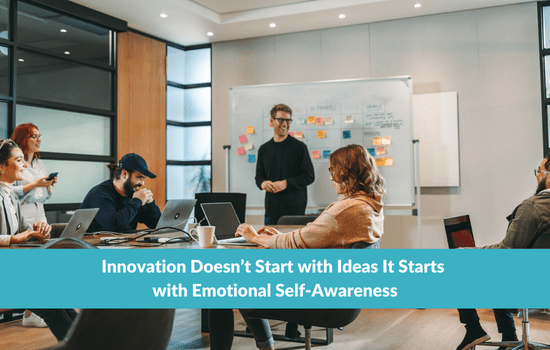
When organizations talk about innovation in the workplace, the focus is usually on strategy, technology, or breakthrough ideas. But innovation rarely fails because of a lack of ideas. More often, it stalls because people hesitate, doubt themselves, or avoid risk when outcomes are uncertain.
This is where emotional intelligence in the workplace becomes essential. Innovation begins internally, with emotional self-awareness. When leaders and teams understand and regulate their emotional responses, they create the conditions necessary for experimentation, adaptability, and growth. Emotional self-awareness strengthens a growth mindset, allowing individuals to move forward despite uncertainty.
Before innovation expands externally, regulation must occur internally.
Imagine a leader hesitating to propose a new strategy because they fear criticism, or an employee abandoning a promising idea after one failed attempt. In these moments, innovation is not limited by intelligence or talent. It is limited by emotional response.
The Neuroscience of Fear and Innovation
Innovation requires risk, and risk activates the brain’s threat detection system.
Research from Daniel Goleman describes this as an “amygdala hijack,” also known as emotional hijacking, when emotional centers override rational thinking. In high-stress situations, cognitive flexibility decreases. When that happens:
-
Creativity narrows
-
Problem-solving declines
-
Defensive thinking increases
Similarly, research by Harvard Business School professor Teresa Amabile found that positive emotional states significantly enhance creativity, while fear and pressure diminish it.
If employees operate in chronic stress, innovation slows, not because of a lack of ideas, but because emotional responses remain unmanaged.
This is why managing workplace stress becomes a strategic advantage, not simply a wellness initiative.
Innovation Requires Emotional Agility, Not Emotional Suppression
Many professionals believe that being “professional” means suppressing emotion.
Interestingly, research suggests the opposite.
Psychologist Susan David, author of Emotional Agility, emphasizes that sustainable performance depends on acknowledging emotions rather than avoiding them. Suppression increases internal tension and reduces adaptability.
True emotional agility includes:
-
Recognizing fear without being ruled by it
-
Experiencing discomfort without retreating
When people feel psychologically safe enough to acknowledge uncertainty, they become more willing to experiment. And experimentation is the foundation of innovation.
Growth Mindset Is Strengthened Through Emotional Awareness
Carol Dweck’s research on growth mindset shows that individuals who believe abilities can be developed are more resilient in the face of setbacks.
However, mindset alone is not enough. Emotional self-awareness strengthens a growth mindset because it helps individuals recognize the internal narratives that arise during failure:
“I’m not good at this.”
“This proves I can’t lead.”
“I shouldn’t have tried.”
Without awareness, these thoughts automatically shape behaviour.
With emotional self-awareness, individuals create a pause between stimulus and response. That pause allows intentional action instead of reactive withdrawal. Intentional action sustains innovation.
Stress Management Creates Cognitive Space for Innovation
The American Psychological Association reports that chronic workplace stress impairs concentration, memory, and decision-making, all functions required for innovation.
Innovation requires cognitive space. When individuals actively manage workplace stress, they restore:
-
Mental clarity
-
Cognitive flexibility
-
Openness to new perspectives
Stress itself is not inherently harmful. Moderate challenge can enhance performance. However, unmanaged stress constricts thinking and reduces creative capacity.
Organizations that invest in emotional intelligence in the workplace consistently see stronger collaboration, better decision-making, and higher engagement. These conditions allow innovation to thrive.
Small Emotional Shifts Lead to Meaningful Innovation
Breakthrough innovation often begins with small internal changes. For example:
-
Choosing curiosity instead of self-criticism
-
Reframing failure as feedback
-
Responding thoughtfully instead of defensively
-
Challenging one limiting belief
These micro-shifts compound over time.
Behavioural science research shows that incremental emotional and cognitive adjustments produce lasting performance improvements. Emotional regulation strengthens adaptability. Adaptability strengthens experimentation. Experimentation strengthens innovation.
This is why emotional self-awareness is not a soft skill. It is a performance skill.
A Practical Exercise to Strengthen Emotional Self-Awareness
The next time you feel hesitation, frustration, or self-doubt in the workplace, pause and ask yourself:
What emotion am I experiencing right now?
What is this emotion trying to protect me from?
This simple pause activates the rational brain and reduces emotional reactivity. It restores clarity, allowing individuals to respond intentionally rather than react automatically.
Over time, this strengthens emotional intelligence and supports a growth mindset, both essential for innovation.
Key Takeaways
- Innovation requires emotional agility, not emotional suppression
- Emotional self-awareness strengthens a growth mindset and resilience
- Managing workplace stress creates the cognitive space necessary for creativity
- Emotional intelligence in the workplace directly influences adaptability and innovation
- Small emotional shifts lead to meaningful and sustainable professional growth
Innovation Begins Internally
Innovation in the workplace is not purely a strategic or intellectual process. It is an emotional one.
Before ideas ever reach the whiteboard, they must first survive our internal dialogue. Emotional intelligence allows individuals to manage fear, uncertainty, and self-doubt so they can move forward with clarity and confidence. Emotional self-awareness strengthens a growth mindset, enabling leaders and teams to remain open, adaptable, and resilient.
Organizations that prioritize emotional intelligence in the workplace create environments where innovation becomes sustainable, not accidental. Marshall Connects offers Emotional Intelligence Assessments and Coaching designed to help leaders strengthen emotional self-awareness, resilience, and performance. The EQ-i 2.0 Assessment provides clear insight into how emotional intelligence influences leadership effectiveness, workplace innovation, and long-term professional growth.
More Motivational Reads Here »
How Emotionally Intelligent Are You?
Sign up for Linda’s monthly tips to build your Emotional Intelligence and reduce Emotional Hijacking!