
In today’s rapid-paced, emotionally charged world, our ability to manage emotional reactions is more critical than ever. Emotional hijacking, when strong emotions override rational thinking, can erode decision-making, strain relationships, and diminish performance. Research consistently shows that strengthening emotional intelligence, particularly self-awareness, is one of the most effective ways to build resilience, increase emotional control, and reduce emotional reactivity.
Reclaiming Emotional Control: Surprising Tactics to Reduce Emotional Hijacking
Neuroscience and leadership research confirm that individuals who intentionally develop emotional awareness are better equipped to pause, regulate emotional responses, and choose thoughtful action rather than impulsive reaction. This ability to recognize emotional triggers before they escalate is foundational to emotional resilience, supporting clearer judgment, stronger communication, and sustained well-being in both personal and professional contexts.
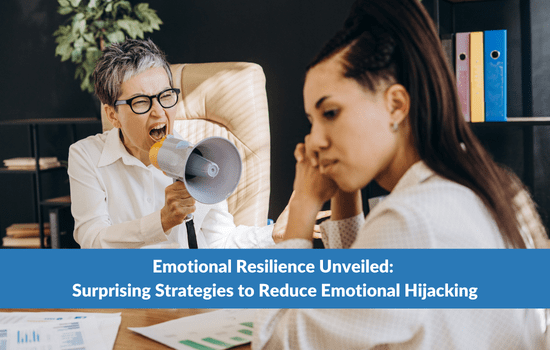
Strengthening emotional control through emotional intelligence enables individuals to interrupt automatic reactions and respond with intention, an essential skill for minimizing emotional hijacking and reducing emotional reactivity.
Emotional Regulation Is About Mastery, Not Suppression
Anyone can become angry–that is easy. But to be angry with the right person, to the right degree, at the right time, for the right purpose, and in the right way-that is not easy. – Aristotle
Modern research strongly supports Aristotle’s insight. Emotional regulation is not about suppressing emotions; it is about understanding, managing, and channelling them effectively. Studies published in Harvard Business Review show that individuals with higher emotional intelligence demonstrate greater adaptability, stronger relationships, and improved stress management, core components of emotional resilience.
When emotions are understood rather than ignored, individuals gain greater control over their reactions, enabling thoughtful responses even in emotionally charged situations.
The Influence of Your Emotions
Developing emotional intelligence, particularly self-awareness, fundamentally changes how we behave, make decisions, and respond to stress. Self-awareness allows us to recognize emotional patterns and understand how emotions influence judgment and interpersonal interactions. According to McKinsey & Company, leaders and professionals with strong emotional self-awareness are significantly more effective decision-makers, especially under pressure.
Managing emotions comes next, and this requires practice. Emotional regulation is a learned skill that strengthens over time, enabling individuals to respond intentionally rather than impulsively. This skill is essential for reducing emotional reactivity and building sustainable emotional resilience.
What is Emotional Hijacking?
Emotional hijacking occurs when intense emotions such as anger, fear, or excitement temporarily override the brain’s rational decision-making processes. During these moments, behaviour is driven by emotion rather than logic, often leading to outcomes we later regret.
Psychologist Daniel Goleman introduced the term “amygdala hijack” in his seminal work Emotional Intelligence: Why It Can Matter More Than IQ. The amygdala, located in the brain’s temporal lobe, plays a key role in processing emotions and triggering the fight-or-flight response. When perceived threats arise, the amygdala can bypass the rational brain, leading to impulsive reactions.
Why Do We Get Emotionally Hijacked?
Emotional hijacks often occur suddenly and unexpectedly. A critical comment from a colleague, an unmet expectation, or perceived disrespect can trigger an intense emotional response within seconds. Neuroscience research confirms that under stress, emotional responses activate faster than rational thought, making impulsive reactions more likely (American Psychological Association).
Without sufficient self-awareness and emotional control, individuals may lash out, withdraw, or make decisions that damage relationships and credibility. These moments frequently lead to regret, highlighting the importance of strengthening emotional resilience and emotional intelligence. For deeper insight into how emotions influence behaviour and decision-making, The Power of Emotion explores this dynamic extensively.
How Even Positive Moods Can Trigger Emotional Hijacking
Emotional hijacking doesn’t only occur during negative emotions. Excitement, anticipation, or overconfidence can also impair judgment. Impulse purchases, overcommitting, or taking unnecessary risks often stem from positive emotional hijacks.
Research in behavioural psychology confirms that heightened emotional states, positive or negative, reduce rational evaluation and increase impulsivity (Harvard Business Review). This reinforces the importance of reducing emotional reactivity across all emotional states, not just during stress or conflict.
Seven Strategies to Build Emotional Resilience and Reduce Emotional Hijacking
Strengthening emotional resilience begins with intentional self-regulation. Neuroscience research shows that pausing and regulating breathing can calm the nervous system in under 10 seconds, allowing the rational brain to re-engage (PubMed).
Here are seven research-supported strategies to increase self-awareness and emotional control:
-
Recognize the signs – Identify physical and emotional cues signalling an emotional hijack.
-
Pause and breathe – Controlled breathing activates the parasympathetic nervous system, reducing stress responses.
-
Name your emotions – Labelling emotions increases cognitive control and reduces emotional intensity.
-
Challenge your thoughts – Question assumptions rather than accepting emotional narratives as fact.
-
Practice empathy – Empathy shifts focus outward and reduces emotional escalation.
-
Engage in self-care – Sleep, movement, and recovery build emotional resilience and lower reactivity.
-
Develop emotional intelligence – Understanding emotional triggers improves communication, empathy, and decision-making (McKinsey, 2024).
Consistent practice of these strategies strengthens emotional intelligence and significantly reduces emotional hijacking over time.
Reducing emotional hijacking is not about suppressing emotions; it is about understanding and managing them with intention. When individuals strengthen emotional intelligence, cultivate self-awareness, and practice emotional control, they significantly reduce emotional reactivity and build lasting resilience.
Emotional resilience allows us to respond thoughtfully rather than react impulsively, especially under pressure. Over time, these skills transform how we communicate, make decisions, and navigate challenges, leading to stronger relationships, improved performance, and greater personal well-being.
At Marshall Connects, Emotional Intelligence Assessments and Coaching are designed to help individuals deepen self-awareness, strengthen emotional control, and build resilience that supports sustainable success. When emotional intelligence is practiced consistently, it becomes a powerful catalyst for clarity, confidence, and meaningful connection, at work and in life.
This article was originally published on November 2, 2019, and has been updated (February 2026).
More Motivational Reads Here »
How Emotionally Intelligent Are You?
Sign up for Linda’s monthly tips to build your Emotional Intelligence and reduce Emotional Hijacking!